Back to Courses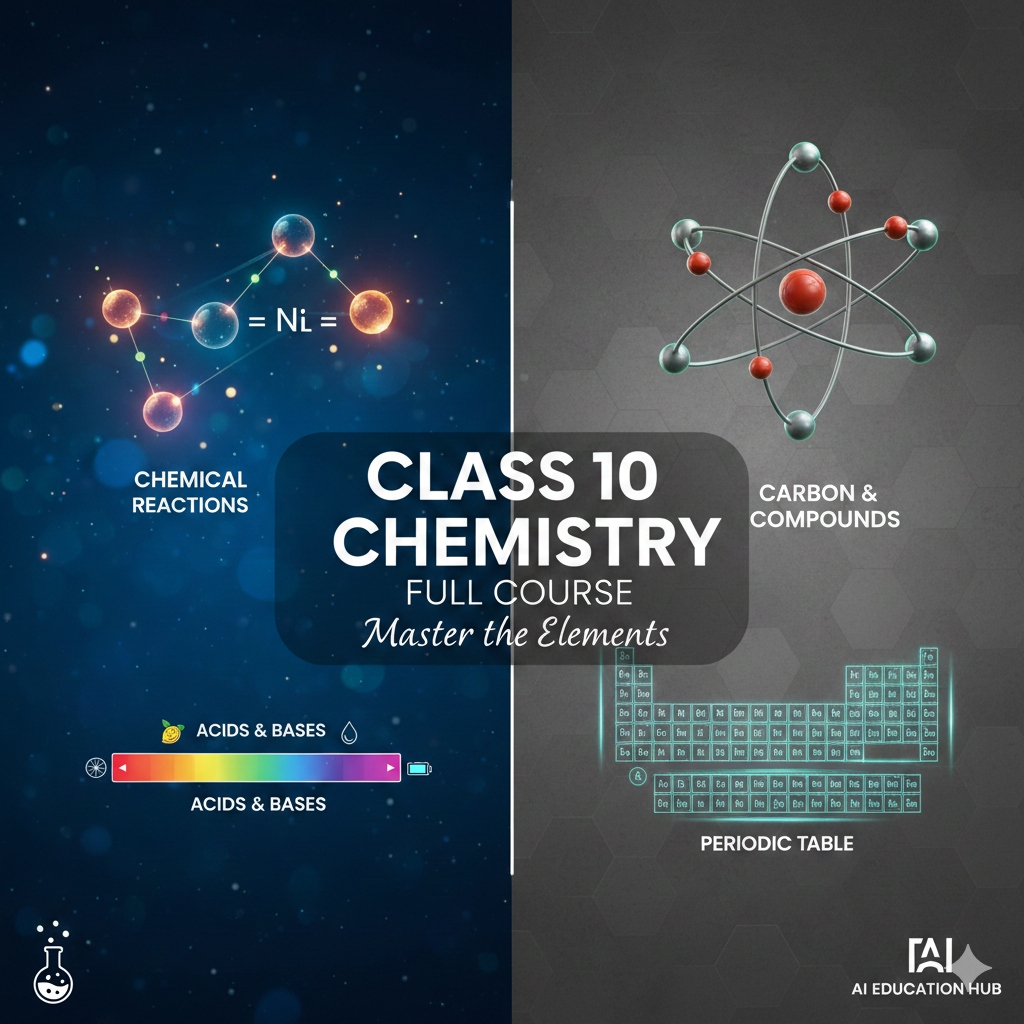

ChemistryClass 10
Class 10 Chemistry: Complete Course Syllabus
This course is designed to cover the fundamental principles of chemical reactions, the nature of matter, and the periodic behavior of elements, aligning with standard international and national curricula (like CBSE, ICSE, or IGCSE).
Core Focus Areas
- Master the art of writing and balancing chemical equations.
- Understand the chemical properties of acids, bases, and salts including pH scale.
- Explore the physical and chemical behavior of metals and non-metals.
- Gain deep insights into the versatile nature of carbon and its compounds.
- Understand the logic behind the periodic classification of elements.
- Learn about redox reactions and their applications in daily life.
Comprehensive Syllabus
Module 1: Chemical Reactions and Equations
Transformation of substances and their representation.
Chemical Equations
Writing and balancing chemical equations; significance of a balanced equation.
Types of Chemical Reactions
Combination, Decomposition, Displacement, Double Displacement, Precipitation, and Neutralization.
Oxidation and Reduction
Understanding Redox reactions in terms of gain/loss of oxygen and electrons.
Everyday Chemistry
Corrosion and Rancidity—causes and prevention.
Module 2: Acids, Bases, and Salts
Chemical properties based on pH levels.
Nature of Substances
Indicators (Natural and Synthetic), Olfactory indicators.
Chemical Properties
Reactions with metals, metal carbonates, and hydrogen carbonates.
The pH Scale
Concept of pH, its importance in daily life (digestive system, tooth decay, soil pH).
Common Salts
Preparation and uses of Sodium Hydroxide, Bleaching Powder, Baking Soda, Washing Soda, and Plaster of Paris.
Module 3: Metals and Non-Metals
Physical and chemical behavior of elements.
Properties
Physical and chemical properties of metals and non-metals.
Reactivity Series
Understanding the displacement of metals and the logic behind the series.
Ionic Compounds
Formation, properties, and high melting points.
Metallurgy
Extraction of metals, enrichment of ores, and refining.
Prevention of Corrosion
Galvanization, alloying, and painting.
Module 4: Carbon and its Compounds
Organic chemistry and the unique bonding nature of carbon.
Covalent Bonding
Electron dot structures of ammonia, methane, and water.
Versatile Nature of Carbon
Catenation and tetravalency.
Homologous Series
Functional groups (Halogens, Alcohols, Ketones, Aldehydes, Alkanes, Alkenes, Alkynes).
Chemical Properties of Carbon
Combustion, oxidation, addition, and substitution reactions.
Ethanol and Ethanoic Acid
Properties and industrial uses.
Soaps and Detergents
Micelle formation and cleansing action.
Module 5: Periodic Classification of Elements
History and logic behind the organization of elements.
Early Attempts
Dobereiner’s Triads, Newlands’ Law of Octaves, Mendeleev’s Periodic Table.
Modern Periodic Table
Position of elements, groups, and periods.
Periodic Trends
Valency, Atomic size, Metallic and Non-metallic properties, and Electronegativity.
Requirements
- •Basic understanding of Class 9 Chemistry concepts.
- •A desire to explore the building blocks of the universe.
- •Basic mathematical skills for balancing equations.
Frequently Asked Questions
One-time payment
• Difficulty: Intermediate
• Target Audience: Class 10 Students
• Certificate of completion
Your Instructor
Celoris Designs llp
Course Provider
Providing state-of-the-art educational content for secondary school students worldwide.
4.9(124 reviews)
Full Year
124 enrolled