Back to Courses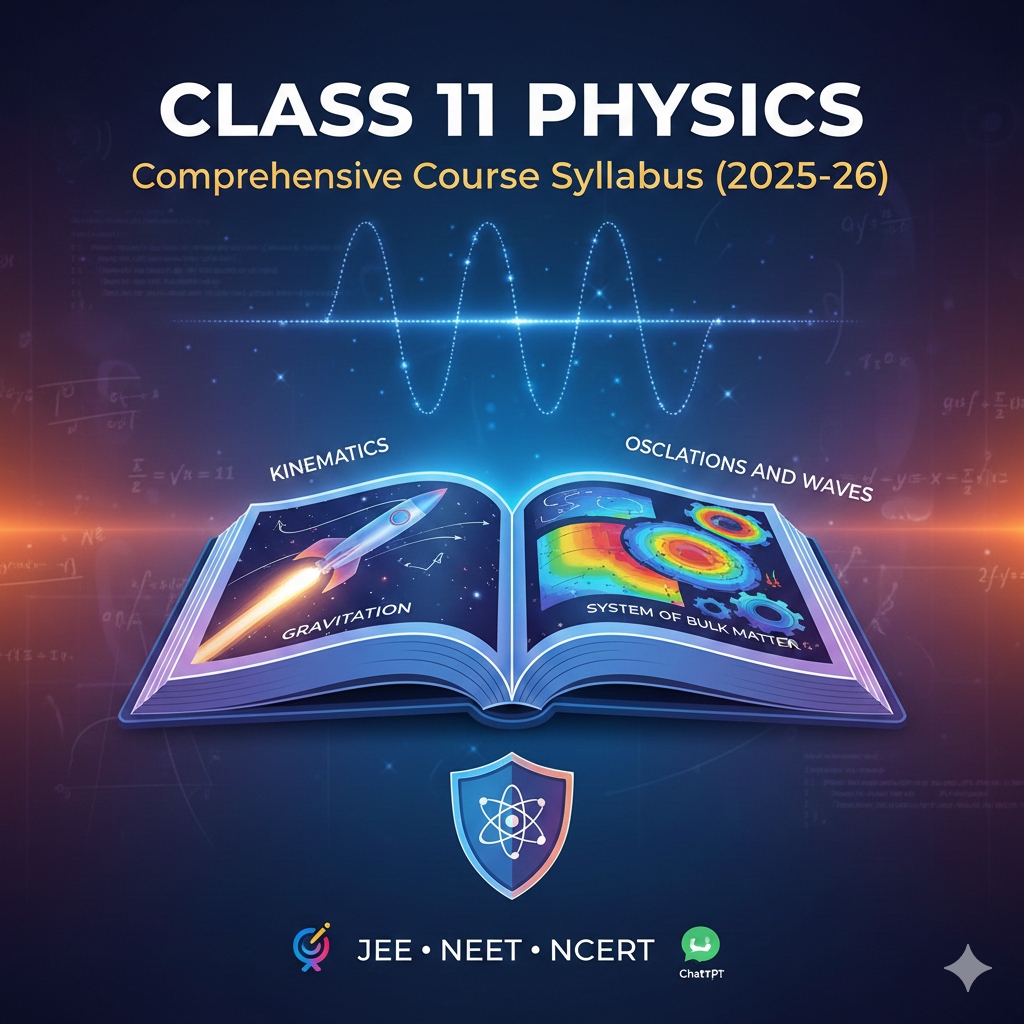

PhysicsClass 11th
Class 11 Physics: Comprehensive Course Syllabus (2025-26)
This course is designed to provide a conceptual foundation for board exams and competitive tests like JEE and NEET. It covers the entire official curriculum with a core focus on Classical Mechanics, Thermodynamics, and Oscillatory Motion.
Core Focus Areas
- Master Classical Mechanics: Laws of Motion, Work, Energy, Power, and Rotational Motion.
- Understand Thermodynamics: Laws of Thermodynamics, Heat Engines, and Kinetic Theory of Gases.
- Explore Oscillations and Waves: SHM, Wave Motion, and Doppler Effect.
- Grasp Gravitation and Properties of Matter: Planetary Motion, Solids and Fluids mechanics.
- Build strong foundation for JEE/NEET competitive exams.
Comprehensive Syllabus
Unit 1: Physical World and Measurement
Units and Measurements
The international system of units (SI), fundamental vs. derived units, and significant figures.
Dimensional Analysis
Dimensions of physical quantities, dimensional formulae, and their applications in checking the accuracy of equations.
Unit 2: Kinematics
Motion in a Straight Line
Frame of reference, position-time graphs, instantaneous velocity, and kinematic equations for uniformly accelerated motion.
Motion in a Plane
Scalar and vector quantities, resolution of vectors, projectile motion, and uniform circular motion.
Unit 3: Laws of Motion
Newton’s Laws
Inertia, Newton’s first, second, and third laws of motion, and the concept of impulse.
Dynamics of Friction
Static and kinetic friction, laws of friction, and lubrication.
Circular Motion Dynamics
Centripetal force and motion on banked roads.
Unit 4: Work, Energy, and Power
Work-Energy Theorem
Work done by constant and variable forces, kinetic energy, and potential energy of a spring.
Collisions
Elastic and inelastic collisions in one and two dimensions.
Unit 5: System of Particles and Rotational Motion
Rigid Body Dynamics
Centre of mass, torque, angular momentum, and conservation of angular momentum.
Moment of Inertia
Radius of gyration and values for simple geometrical objects.
Unit 6: Gravitation
Planetary Motion
Kepler’s laws and Newton’s universal law of gravitation.
Satellites
Escape speed, orbital velocity, and geostationary satellites.
Unit 7: Properties of Bulk Matter
Solids
Stress-strain relationship, Hooke’s law, and Young’s modulus.
Fluids
Pascal’s law, Bernoulli’s theorem, viscosity, and surface tension.
Thermal Properties
Specific heat capacity, calorimetry, and Newton's law of cooling.
Unit 8: Thermodynamics
Laws of Thermodynamics
Zeroth law (temperature), First law (internal energy), and Second law (entropy).
Heat Engines
Reversible/irreversible processes and the Carnot engine.
Unit 9: Kinetic Theory of Gases
Gas Laws
Equation of state of a perfect gas and assumptions of kinetic theory.
Degrees of Freedom
Law of equipartition of energy and mean free path.
Unit 10: Oscillations and Waves
Simple Harmonic Motion (SHM)
Energy in SHM, simple pendulum, and force constants.
Wave Motion
Longitudinal and transverse waves, superposition principle, beats, and the Doppler effect.
Requirements
- •Class 10th Pass with Science stream.
- •Strong grasp of basic mathematics (Algebra, Trigonometry).
- •Dedication to conceptual learning.
Frequently Asked Questions
One-time payment
• Course difficulty: Intermediate to Advanced
• Target Audience: Science Stream
• Certificate of completion
Your Instructor
Celoris Designs
Course Instructor
Expert faculty dedicated to providing a deep conceptual understanding of Physics for Board and Competitive exams.
4.9(85 ratings)
Full Year
85 enrolled